
A condensate pump costs around $100 and sits quietly beside your air handler, moving the water your AC pulls out of indoor air to a drain. Most homeowners never think about it — until a musty smell, a ceiling stain, or a surprise repair bill forces the question. The uncomfortable truth is that when this small device is mounted in the wrong spot, it can quietly undermine a $6,000 system over just a few seasons, stealing years of compressor life while the unit still appears to “work fine.”
The good news: the warning signs are specific, the correct placement rules are simple to check, and most of the damage can be prevented without any DIY risk. The sections below walk through how the pump fits into your system, how bad placement causes a slow-motion failure, what to look for in your own home, and how to make sure the next service visit actually fixes the root cause.
What this guide delivers for your AC decision
- A poorly placed condensate pump can quietly shave 3 to 5 years off a compressor’s useful life.
- Back-pressure from a pump mounted too high forces water to sit in the drain pan, accelerating corrosion and mold.
- The same problem can push a system to short-cycle, which can erode SEER performance by roughly 10–15%.
- Five concrete symptoms let you diagnose the issue before calling a technician.
- Correct placement rules are simple enough to verify visually or request from any contractor.
The condensate pump’s role inside your AC system
Every central AC pulls humidity out of indoor air. When warm, humid air passes over the cold evaporator coil inside your air handler, moisture condenses on the fins — the same way a cold glass sweats on a summer afternoon. That water drips into a shallow metal tray underneath called the drain pan, and from there it has to leave the house. In a Sun Belt climate like suburban Atlanta, a 3-ton system running most of the year can generate several gallons of condensate on a humid day, so this drainage path isn’t optional plumbing — it’s part of how the system stays healthy.
Drainage works in one of two ways. In a gravity-fed setup, the drain pan sits high enough above the outside world that water simply flows downhill through a PVC line, usually passing through a P-trap (a small U-shaped bend that blocks air from being sucked back up the line). When gravity isn’t available — attics, closets, basements below the yard grade — a small electric condensate pump takes over. Think of it as an assistant to gravity: it collects the water in a reservoir, waits until a float rises, then pushes the water uphill through a thin discharge line to a drain or the outdoors. For a homeowner’s catalog of pump-compatible systems, you can explore Westpoint air conditioning units designed around modern residential drainage layouts.
In most American homes, the pump sits on the floor of the attic, closet, or basement — right next to the air handler, at or just below the level of the drain pan outlet. In Derek’s case, a rushed replacement in a tight attic crawlspace can leave the pump suspended, tilted, or placed above the pan to save space. That’s where the trouble starts, because physics doesn’t care about convenience. According to the ACCA guide on HVAC condensate management, pump output drops as the required lift height increases, until it reaches a shut-off point where no water moves at all.
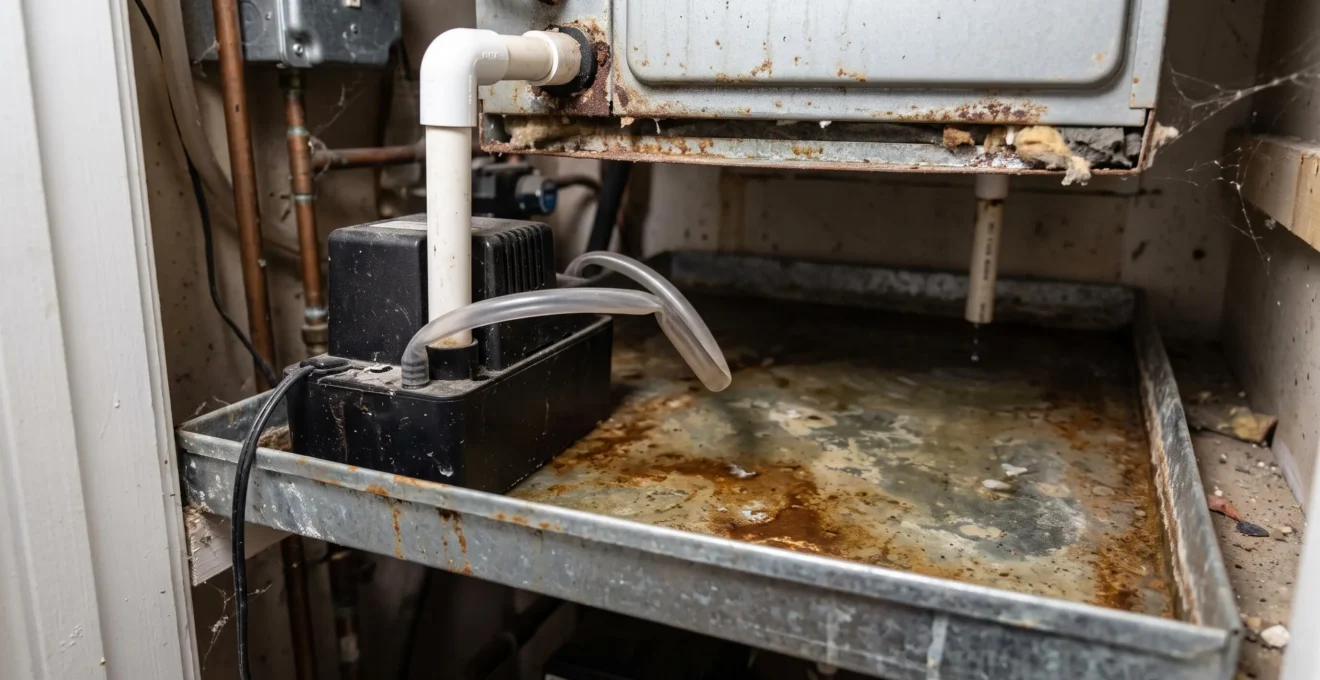
The parcours is simple to picture: evaporator coil → drain pan → P-trap → condensate pump → discharge line → outside. Every link in that chain depends on the one before it. When the pump can’t keep up, water backs up into the pan, and the pan starts to behave like a stagnant pond sitting directly under the coldest, most sensitive parts of your system.
How does a poorly placed condensate pump damage your AC?
Direct answer: Yes. A pump mounted too high or too far from the drain pan creates back-pressure that leaves water sitting in the pan. Over months, that stagnant water corrodes the coil, feeds mold growth, and triggers the overflow float switch, which shuts down the system repeatedly. That short-cycling pattern is one of the fastest ways to wear out a compressor — the single most expensive component in your AC.
The damage unfolds in a chain, not a single event. Step one is back-pressure: when the pump has to lift water higher than its design allows, flow slows down. The ACCA notes that condensate flow decreases proportionally to lift height until a shut-off point. Water begins to pool in the drain pan instead of leaving cleanly. Step two is coil corrosion and mold. The EPA guidance on cooling coil moisture and indoor air quality is explicit on this point: standing water in the condensate pan is a problem requiring immediate attention, because cooling coils are a major source of moisture contamination that can lead to mold growth. That musty smell drifting from Derek’s supply vents? It’s a textbook symptom.
Step three is where the compressor enters the picture. Most modern systems include a float switch (also called an overflow switch) that cuts power when water rises too high in the pan. It’s a safety feature designed to prevent ceiling damage — exactly the kind of water stain Derek already sees. But when the switch trips repeatedly, the system turns on and off in short bursts instead of running full cycles. This is short-cycling, and it’s brutal for the compressor. Each startup draws heavy electrical current and mechanical stress. Multiplied by hundreds of extra cycles per season, the wear accumulates fast.
3–5 years lost
Estimated reduction in AC compressor lifespan when chronic drainage back-pressure causes repeated short-cycling, based on the documented mechanical stress of frequent restart cycles.
The timeline Derek should visualize looks something like this. Month 1: intermittent backflow, nothing visible yet. Month 6: the pan overflow switch starts tripping on humid afternoons, often blamed on a “random glitch.” Month 12: the musty smell appears, the first water stain shows up on the ceiling below the air handler, and a technician might clean the pan without diagnosing the real cause. Month 24: short-cycling becomes a daily pattern, electricity bills creep upward, cooling feels uneven. Month 36 and beyond: the compressor begins to fail prematurely — and the quote arrives at $6,000 for a system that should have lasted another half-decade.
The EPA Mold Course on HVAC condensate drain pans adds a collateral concern: poorly draining pans inside air handling units are a documented source of biological contamination, which affects indoor air quality and can prolong respiratory issues for the whole household. The pump placement question isn’t just about machinery — it’s about what’s circulating through every vent in the home.
Five warning signs your condensate pump is in the wrong spot
Most of these signs are things a homeowner can notice without touching the equipment. The point isn’t to diagnose like a technician — it’s to recognize the pattern early enough to request the right fix. Each symptom below includes what’s happening mechanically and whether it’s a “watch closely” or “call now” situation.
- Gurgling or bubbling sound near the air handlerWhat it means: air is being pulled back through the drain line because water can’t flow out smoothly. This often points to a pump straining against too much lift or a compromised P-trap. Urgency: watch closely over the next two weeks.
- Water stain on the ceiling or floor below the air handlerWhat it means: the pan has overflowed at least once, which only happens when drainage has failed and the float switch didn’t catch it in time — or caught it after water escaped. Urgency: call now.
- Musty, mildew-like smell from supply ventsWhat it means: stagnant water in the pan is cultivating biological growth that the airflow then distributes through the ducts. The EPA links this directly to poorly draining pans. Urgency: call within days.
- System shutting off unexpectedly and restarting a few minutes laterWhat it means: the float switch is tripping on high water, cutting power to the air handler, then releasing once the level drops slightly. This is the early phase of short-cycling. Urgency: call now — this is the pattern that damages the compressor.
- Unexplained increase in cycling frequency or electricity useWhat it means: the compressor is restarting more often than needed, either from float switch interruptions or from reduced cooling efficiency as the coil corrodes. Urgency: watch closely, and bring it up at the next service call.
If two or more of these appear at once, the probability that pump placement is the root cause rises sharply. The combination of a musty smell and a ceiling stain is particularly telling — those two symptoms rarely occur together for any other reason.
Where should a condensate pump be installed to protect your AC?
The core principle is almost disappointingly simple: the pump should make the water’s job easier, not harder. That means positioning it so gravity does as much of the work as possible, with the pump only handling the lift that gravity can’t. Here are the rules a homeowner can verify visually, or ask a technician to confirm in writing.
The four placement rules that matter most:
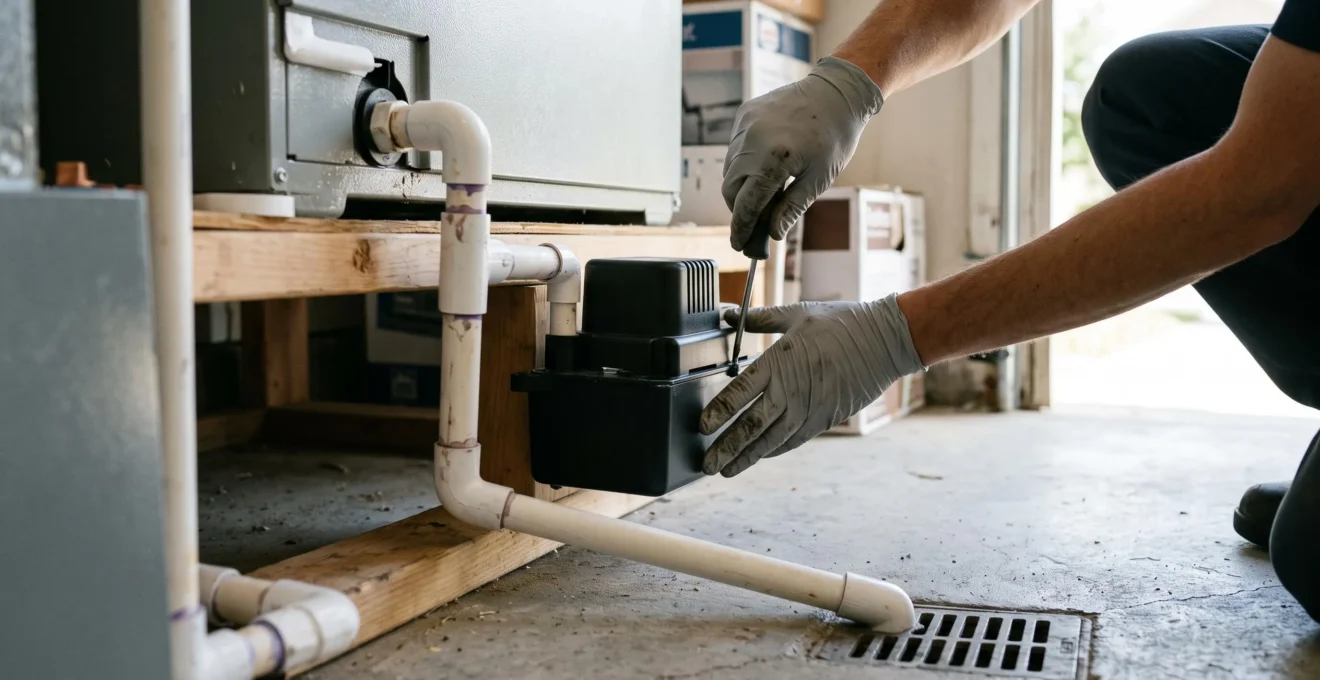
(1) The pump reservoir should sit at or just below the drain pan outlet, never mounted above it.
(2) The pump should be as close to the drain pan as the PVC run allows, minimizing horizontal distance.
(3) The surface under the pump must be level and stable, with vibration isolation when possible.
(4) The discharge line should slope consistently downward wherever gravity permits, with no kinks or long horizontal runs.
Height matters most. When the pump sits above the drain pan outlet, water has to travel uphill before even reaching the pump — and that back-pressure is exactly what causes the pan to fill. The pump should receive water that has already flowed downward from the pan. If you can see the pump mounted on the side of the air handler, up near the coil access panel, that’s a red flag worth questioning.
Distance matters next. A long horizontal run between the pan and the pump means more opportunities for sagging PVC, trapped air, and biological buildup. Shorter is better, and the line between pan and pump should have a visible downward slope, not a flat or dipping path.
Stability and level are the quiet rules. A pump sitting on uneven attic decking vibrates, which loosens fittings and shortens the pump’s own service life. A small piece of rubber or a dedicated vibration pad under the housing can add years. The P-trap on the drain line also needs clearance — it should hang freely without being compressed against joists or insulation.
Attic crawlspaces deserve extra attention. Derek’s situation — a tight attic with limited headroom — is where rushed installations most often go wrong. In those spaces, installers may be tempted to mount the pump wherever it fits rather than where it should go. If the pump isn’t visible from the attic access hatch, or if reaching it requires moving insulation, that’s often a sign placement was dictated by convenience rather than drainage physics. A good technician will document pump height, distance to the pan, and drain line slope as part of any service call.

Does condensate pump placement affect energy bills?
This is where the mechanical problem becomes a financial one. When a system fights chronic drainage back-pressure, the compressor runs harder and cycles more often, which translates directly into higher electricity consumption. The documented impact is a drop in SEER rating — the measure of your AC’s cooling output per watt of electricity consumed — of roughly 10 to 15%. For an Atlanta household running a 3-ton system through a long summer, that’s not a rounding error.
10–15% SEER drop
Approximate loss of seasonal cooling efficiency when a system runs against sustained condensate back-pressure and the short-cycling it causes.
In practical terms: a home that normally pays around $220 per month to cool its space during July and August might watch bills creep to $250 or $260 without any change in thermostat settings, occupancy, or weather. The homeowner typically blames the utility, the heatwave, or the age of the unit — but the real suspect is a pump quietly forcing the compressor to work overtime.
Compressor technology matters here too. Systems built around an Inverter compressor modulate their speed continuously instead of switching fully on and off, which absorbs some of the stress from short-cycling and reduces peak electrical draw. If you’re already considering a replacement or an upgrade and want to limit how much drainage headaches affect long-term operating cost, the inverter-driven options in the Westpoint catalog are designed with this kind of load variability in mind — a meaningful difference compared to older single-stage units that absorb every cycle at full power.
The link between a $100 pump and your $250 power bill isn’t theoretical. It’s the direct outcome of a chain of small physical events: back-pressure increases, water pools, the coil loses efficiency, the compressor cycles more often, and every one of those cycles costs electricity.
Safeguarding your entire HVAC setup for lasting performance
Pump placement is the single highest-impact detail most homeowners never check, but it belongs inside a broader seasonal routine. In a Sun Belt climate where the AC runs most of the year, a short pre-summer inspection pays for itself many times over. The goal isn’t to turn Derek into a technician — it’s to give him enough leverage to request the right work and verify it was done.
Build a five-minute pre-summer check. Walk to the air handler access point. Look for standing water in or around the drain pan, mineral staining along the pan edges, or visible kinks in the PVC discharge line. Listen for gurgling during a cooling cycle. If the system has a visible float switch, confirm it isn’t already resting against the water surface. These observations alone can catch 80% of drainage problems before they become compressor problems.
Right-size and right-spec your equipment. An oversized AC short-cycles even without drainage issues, so compressor stress accumulates faster. If a replacement is on the horizon, prioritize correctly sized, high-efficiency systems — ENERGY STAR certified units with inverter-driven compressors handle variable loads with less strain. For broader home comfort optimization that complements AC performance, the same logic applies to efficient heating solutions on the winter side of the equation.
Choose an installer who documents the details. This is the single best defense against the upsell concern. Ask any contractor two questions before work begins: “Where will the condensate pump be mounted relative to the drain pan, and what slope will the drain line have?” A professional will answer specifically and in writing. Vague answers, or discomfort with the question, are a legitimate signal to get a second quote. The question itself becomes a test of professionalism — the kind of filter that separates a careful installer from a rushed one.
Pros and cons of fixing pump placement proactively
- Protects the compressor — your most expensive component — from avoidable short-cycling wear.
- Can restore 10–15% of SEER efficiency lost to back-pressure, lowering monthly bills.
- Eliminates the mold and musty smell at the source instead of masking symptoms.
- Prevents ceiling and drywall damage from pan overflow events.
- Requires a service call rather than a DIY fix — attic and air handler access carries real risk.
- May reveal secondary issues (corroded pan, failed float switch) that add to the invoice.
- Benefits accumulate over years, so the short-term “the AC still blows cold” test undersells the value.
My AC still blows cold air — can a small pump really be the problem?
Yes. “Still blows cold” is the most misleading indicator in HVAC. Compressor damage from short-cycling is cumulative and silent until the component fails outright. By the time cooling output visibly drops, the compressor is usually weeks or months from a major repair. The warning signs — gurgling, musty smell, ceiling stains, unexplained cycling — appear well before cooling performance does.
How do I know if my pump is above or below the drain pan without climbing into the attic?
You usually don’t need to. Ask the technician on the next visit to photograph the pump position and send you the image. A competent professional will do this without pushback. If a service history exists from the original installation, invoices sometimes note pump location — otherwise, a 10-minute inspection is standard.
How can I avoid being upsold on parts I don’t need?
Ask for the diagnosis in writing before any parts are ordered. Specifically request: current pump position relative to the drain pan, drain line slope measurement, float switch test result, and pan condition. These are objective observations, not opinions. If a quote recommends compressor work, ask whether addressing the drainage first could extend the compressor’s remaining life — a reasonable installer will engage with that question seriously.
Is fixing pump placement really worth a dedicated service call?
Weighed against a potential $6,000 system replacement five years earlier than expected, a service call to reposition a pump and verify the drain line is one of the highest-return maintenance decisions a homeowner can make. If you’re already scheduling seasonal maintenance, add the drainage audit at no extra visit cost.
How quickly should I act if I see a water stain under the air handler?
Within days, not weeks. A visible stain means at least one overflow event has already occurred, and the next one could happen during the next humid afternoon. The float switch may still be working, but relying on it alone is risky — it’s designed as a last-resort safety, not a daily operating condition.
If any of this resonates with what’s happening in your home, the next practical step is to request a drainage audit as part of your next AC maintenance visit, and to document the pump’s exact position. For homeowners who manage multiple properties or want to extend the same preventive logic to larger systems, the frameworks around commercial building energy management offer useful parallels on how small mechanical details compound into major operating costs over time.
The condensate pump sits at the intersection of plumbing and HVAC, which is probably why it gets overlooked by specialists on both sides. But the physics are unforgiving: water that doesn’t drain damages the system that depends on draining it. Catching that early — through a visual check, a specific question to your technician, or a documented placement during the next service — is one of the few $100 decisions that can protect a $6,000 system for its full expected life.